
How does the temperature of your home affect wellbeing?

Many of us have experienced sleepless nights in the summer due to overheating, especially over the last few years, as climate change has kicked in.
The problem is only going to get worse as temperatures in the UK are predicted to increase with more intense and frequent heatwaves, and a massive 80 per cent of houses are affected by overheating.
Unfortunately, people living in cities suffer more from overheating because the density of tall buildings and lack of green spaces mean there is nowhere for heat to escape.
Dehydration
Overheating can cause you to sweat far more during the night.
Without drinking adequate amounts of water, dehydration makes you more likely to suffer headaches, cramps and dizziness.
Bad night's sleep
We all need deep sleep, known as NREM (Non-Rapid Eye Movement) and REM (Rapid Eye Movement), both vital for emotional processing and physical repair, but high temperatures can stop the body from reaching these important stages.
Just missing one night’s sleep can affect your mood, making you feel irritable and less productive at work.
But if you’re missing out on sleep for days or even weeks during a heatwave, it can have a major impact on your wellbeing, causing anger, anxiety, depression, and even suicide.
It can also cause lethargy, loss of concentration, poor judgement and slower-than-usual reaction times, making you less able to cope with events at work and home.
More prone to illness
These extended periods of lack of sleep also have an adverse effect on your immune system, making you more prone to illnesses such as colds and flu.
Add sleep deprivation to constant high day and nighttime temperature conditions, and you create cumulative stress on the human body, increasing the risk of more serious illnesses such as heart failure.
Fatal effect on pre-existing conditions
While overheating can lead to heat exhaustion, it can lead to death for those with pre-existing health conditions.
There were an excess of nearly 3,000 deaths in the UK during 2022 when we experienced several heatwaves over the summer with the peak hitting 40.3° C.
Many were among vulnerable people with pre-existing health conditions who died due to heart attacks, strokes and respiratory problems and kidney problems, exacerbated by high temperatures.
According to the World Health Organisation (WHO), an estimated 61,672 people died from heat-related causes in Europe in 2022.
Heat exhaustion and heatstroke
Young children, older people and pregnant women are more at risk of heat exhaustion because their bodies find it harder to regulate their temperature.
Heat exhaustion can lead to heatstroke which is a very serious condition and should be regarded as a medical emergency.
Symptoms include rapid or shortness of breath and confusion and a high temperature and the patient fitting or losing consciousness.
How can I stop my home overheating?
Many people think opening windows to let air into a room helps to lower temperatures.
However, this only works at night when temperatures have dropped. During the day, opening the windows allows more warm air in, making overheating worse.
The only effective and sustainable way to stop your home from overheating long-term is solar shading. This can be from overhangs, awnings, external blinds or even trees or planting – anything which blocks direct sunlight.
External blinds stop overheating
External blinds block 97 per cent of the sun and therefore stop the problem of overheating in homes happening in the first place.
On average they reduce temperatures inside by at least 5°C – the difference between stifling and comfortable - though our case studies show a much bigger drop on installation.
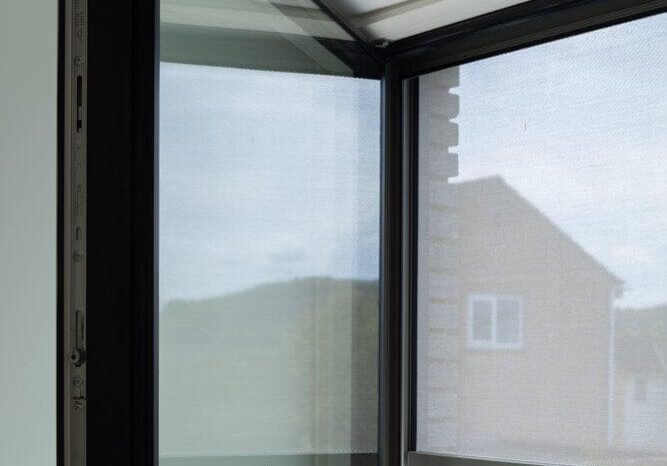
Their special weave allows plenty of light to come into your home, allowing you to see outside while blocking the sun.
Set the temperature to comfortable
Installing external blinds means you can much better control the indoor temperature.
They can be fitted with a sensor so they will automatically raise or lower when the thermometer hits your preferred temperature.
In addition, you can control external blinds through a smartphone or household app, raising and lowering the blinds remotely so you can come home to a comfortable house or flat.
The choice of architects
Kensington’s external blinds are chosen by architects to protect south and west facing windows.
Increasingly, they are seen as a must have feature with many architects including external blinds in their integral design.
Our external blinds can cover all types of glass windows and doors including skylights and corners and are available in a variety of styles and colours to suit the look and feel of your home.
If you’d like to find out more about cost and installation, then please contact us.
Related Content
External Blinds Fabric Guide

Garden Room, Veranda, Pergola or Awning: What’s Actually the Difference?
